


The rapid rise of AI text generators has transformed digital publishing. Between rumors of automatic AI bans and the proliferation of automated content farms, businesses need to separate myth from Google’s actual policy.
Why Google clarified its rules on AI content
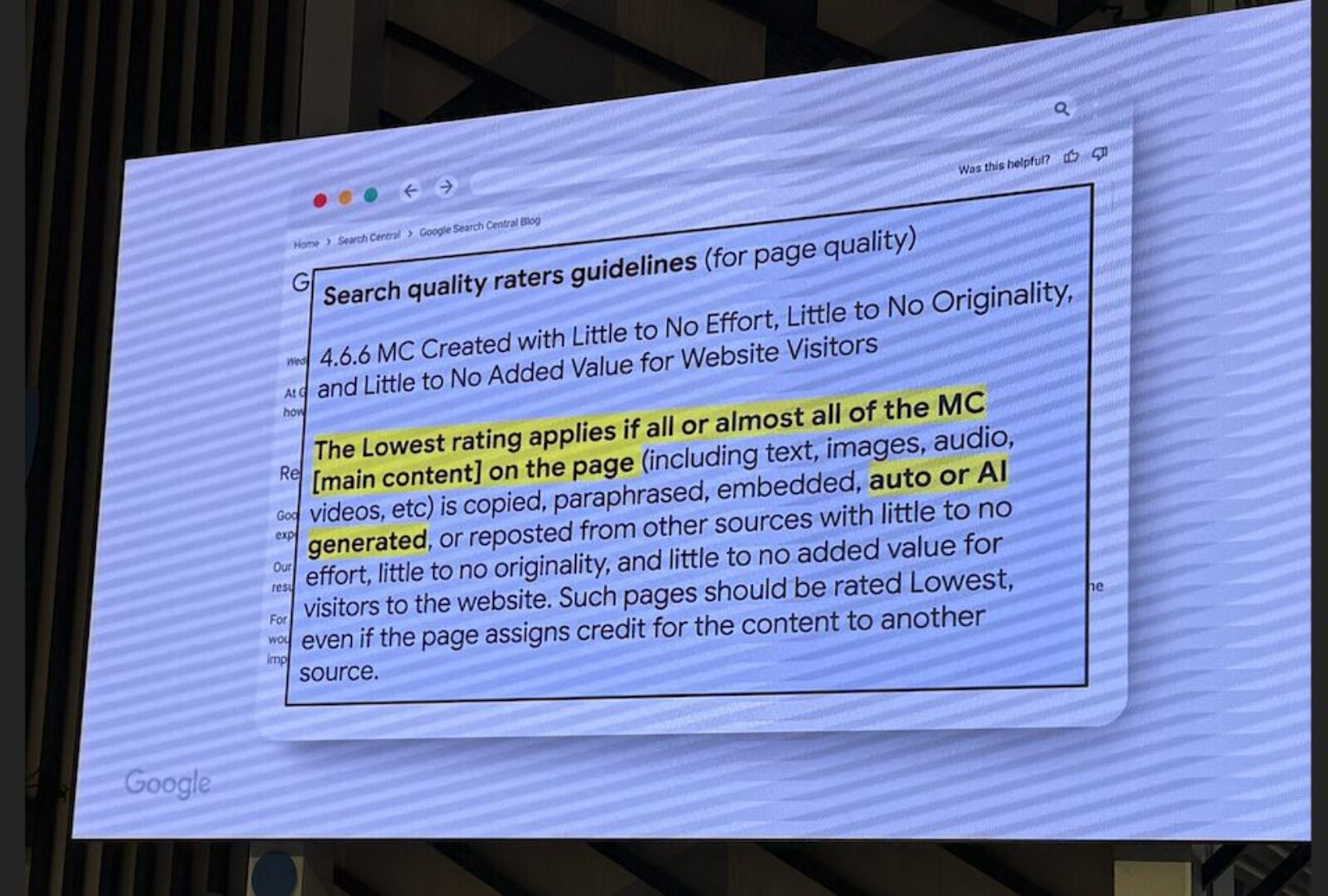
Contrary to popular belief, Google does not penalize content simply because AI assisted in drafting it. Official Google Search Central documentation states clearly that Google rewards helpful, high-quality content regardless of how it is produced.
What Google explicitly sanctions under its spam policies is scaled content abuse—using automation at scale to churn out pages designed to manipulate search rankings without adding real value for readers.
The surge of low-value automated pages
Publishing hundreds of generic pages in minutes is now technically effortless. Yet flooding the web with repetitive, unverified copy degrades search quality and has prompted Google to tighten its automated quality filters.
The inherent limits of 100% raw AI copy
While language models excel at summarizing and structuring ideas, they lack lived experience, critical judgment, and field expertise. Unedited AI copy often reproduces surface-level clichés or subtle factual errors that undermine brand credibility.
How Google evaluates and filters AI content

Rather than relying on brittle “AI text detectors,” Google uses SpamBrain alongside its core helpful-content ranking signals to assess real utility.
Core algorithmic evaluation signals
- Information Gain: Does the page contribute fresh perspectives, data, or analysis—or merely rephrase what already ranks in the top ten?
- Factual accuracy and verifiability: Are claims backed by reliable sources rather than LLM hallucinations?
- Scaled automation patterns: Mass-generating dozens of near-duplicate pages targeting minor keyword variations without genuine user value.
The decisive role of E-E-A-T
Google rewards content grounded in Experience, Expertise, Authoritativeness, and Trustworthiness. A practitioner sharing real client outcomes, pitfalls encountered, and proprietary benchmarks delivers value no generic prompt can replicate.
What is at stake for content creators?
You do not need to ban AI from your editorial workflow—you need to elevate how you use it.
| High-Risk Practice (Penalty Risk) | Recommended Practice (Google-Compliant) |
|---|---|
| Publishing raw AI output without expert human review. | Using AI for outlines and drafts, then editing and enriching with domain experts. |
| Spinning up mass content farms to chase low-intent traffic. | Building authoritative guides featuring case studies, data, and clear takeaways. |
| Anonymous articles with no visible brand or author expertise. | Clear editorial attribution, author bios, cited sources, and transparent contact info. |
Toward AI-assisted, human-led publishing
Treat AI as a research and drafting assistant—never as the final author. Winning brands infuse every published page with their own voice, methodology, and field proof.
Practical steps to protect your SEO
1. Enforce an expert editorial review workflow
- Verify every fact and statistic: Link every claim to a credible primary source.
- Add proprietary insight: Include original screenshots, client case studies, and tested frameworks.
- Eliminate generic AI phrasing: Cut filler introductions, repetitive transitions, and hollow conclusions.
2. Audit for real reader utility
- Does the page completely satisfy the searcher’s underlying intent?
- Would a colleague or customer bookmark or share this page?
- Is the author’s real-world credibility clear and verifiable?
In short, Google does not fight technology—it filters out unhelpful content. Keep human expertise and reader value at the center of your workflow, and AI becomes a safe productivity multiplier.